back to All Authors
Sobey, EdSobey, Ed | Alt 1

Ed Sobey

Ed Sobey is the author of The Motorboat Book, Unscrewed, The Way Toys Work, and The Way Kitchens Work, and many other titles.
Request a Visit
Recent Publicity
9/21/2011 - Unscrewed
See All Publicity

Titles by Ed Sobey

View Filters
Browse Titles 
Narrow Your Search
Titles Found: 9
A Field Guide to Household Technology
A Field Guide to Household Technology (3 Formats) ›
By Ed Sobey
PDF Price 9.99

PDF, EPUB, Mobipocket

Published Apr 2007

Illustrating how a fire alarm detects smoke and what the “plasma” is in a plasma screen television, this fascinating handbook explains how everyday household devices function and operate. More than 180 different household technologies are covered, including gadgets unique to apartment buildings and houseboats. Devices are grouped according to their "habitats"—the living room, family room, den, bedroom, kitchen, bathroom, and basement—and feature a detailed description of what the device does and how it works, as well as a photograph for easy identification. With helpful sidebars describing related technical issues, such as why a cheap dimmer switch can interfere with radio reception, this handbook for curious readers provides carefully detailed descriptions and the history behind many of the older household technologies like toasters and faucets to newer technologies like motion detectors, TiVo, and satellite radio.
A Field Guide to Office Technology
A Field Guide to Office Technology (2 Formats) ›
By Ed Sobey

PDF, EPUB

Published Oct 2007

With more than 160 entries detailing everything from the junk buried in desk drawers to that mysterious box blinking away in the coat closet, this practical guide navigates through modern office technology. Each entry includes a functional description of a device (what it is and how it works) as well as particulars on who invented it and how its design has evolved over the years. Devices are grouped according to their habitats—in the conference room, hanging from the ceiling, or connected to a computer—to assist in quick and easy identification. Solving office mysteries, such as why telephone keypads have their ones in the upper left corner while calculator keypads place the ones in the lower left corner, this fascinating resource decodes the often confusing technological landscapes of everyday offices.
A Field Guide to Roadside Technology
A Field Guide to Roadside Technology (3 Formats) ›
By Ed Sobey
PDF Price 9.99

PDF, EPUB, Mobipocket

Published Jun 2006

This fascinating handbook answers the questions of anyone who has ever wondered about the many strange devices found along the roadside, from utility poles to satellite dishes. Devices are grouped according to their habitats—along highways and roads, atop buildings, near airports, and on utility towers. More than 150 different roadside technologies are covered, and each detailed entry describes what the device does, how it works, and also includes a photograph for easy identification. With helpful sidebars describing related technical issues such as why stoplights are constructed with the red light on top, this handbook for curious readers provides carefully detailed descriptions and the history behind many of the devices that roadside travelers take for granted.
Inventing Toys
Inventing Toys (4 Formats) ›
By Ed Sobey
Trade Paper Price 24.95

Trade Paper, PDF, EPUB, Mobipocket

Published Dec 2001

An intriguing combination of invention and toy making, this guide encourages students to work in teams to design and fabricate working toys while learning the fundamentals of science, design, tool usage, and the creative process. Toys range from cars to electric fans to rockets, and the trial-and-error process that students use to build these toys allows them to refine their models through experimentation—building, conducting tests, collecting and interpreting data, and making changes or improvements to their inventions. There are directions for seven workshops and suggestions for five more, and the science concepts and historical background involved in each project are explained for teachers.
Loco-Motion
Loco-Motion ›
By Ed Sobey
Price 24.95

Trade Paper

Published Aug 2005

Using the concept of "learning by doing," this classroom activity book contains an impressive collection of instructions and guidelines for building physics models that fly through the air, drive on the ground, or paddle through water. Students will use experimentation and analysis in these intriguing physics projects to inspire new and improve upon old designs. Each model is presented in a specific educational context, so teachers can instruct with hands-on experimentation. Students will explore science concepts such as gravity, air pressure, kinetic energy, Newton's laws, electrical circuitry, buoyancy, and inertia. Detailed materials lists and step-by-step directions for building models are structured so that the teacher becomes the director of research and development in a classroom of young engineers. The models discussed in the book include gravity-powered cars, balloon racers, hovercrafts, gravity ball launchers, flying saucers, catapults, chemical mini-rockets, swamp boats, and submarines. Kids are encouraged to test, modify, and redesign based on observation of their models in action, while working cooperatively and learning from one anothers' successes and failures. The engaging material in these activities promote the understanding of science not as a collection of facts to be studied for a test, but as a learning process to be actively experienced.
The Motorboat Book
The Motorboat Book (4 Formats) ›
By Ed Sobey
Trade Paper Price 14.95

Trade Paper, PDF, EPUB, Mobipocket

Published Mar 2013

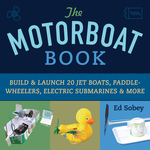
There’s more than one way to power a toy boat. Electric motors, balloons, gears, water jets, belt drives, chemical reactions, steam, and even gravity can be used to propel a small ship across a pool. Also, the boats’ propellers and paddles can be side-mounted or at the stern, or even sit above the waterline, like a fan-powered swamp boat. The Motorboat Book will show children how to build more than 20 different models through step-by-step instructions with clear photos. And if they’d rather travel under the water than over it, the book has 6 different submarine projects.

            In addition to the boatbuilding activities, author Ed Sobey includes instructions on how to build an “ocean” to test the boats, as well as accessories such as four different water pumps, waterproof battery and motor cases, and a working foghorn. Most of the boats are built from recycled and easy-to-find materials, but an appendix lists local and online sources for wire, plastic propellers, small motors, and more. Educators will appreciate the Meeting Science Standards summary at the end of the book.

The Way Kitchens Work
The Way Kitchens Work (4 Formats) ›
By Ed Sobey
Trade Paper Price 14.95

Trade Paper, PDF, EPUB, Mobipocket

Published Apr 2010

If you’ve ever wondered how a microwave heats food, or why aluminum foil is shiny on one side and dull on the other, or whether it is better to use cold or hot water in a garbage disposal, you should read The Way Kitchens Work. Modern kitchens are hi-tech marvels, with more machinery than any other room in the house. Each of the 50+ entries includes its history, interesting trivia, and a discussion of the technology involved.

            Readers will also enjoy reviewing the utensils’ and appliances’ original patent blueprints, as well as photos of the “guts” of these culinary tools. The author even includes odd side stories, such as how the waffle iron played a role in the founding of Nike, how you can reset a turkey timer, and why socialite Josephine Cochran really invented the dishwasher in 1886--it wasn’t because she wanted to ease the burden of her servants, but because she wanted a device that would avoid the unsightly chips associated with hand washing.

            And finally, for those whose stovetop skills are still in development, Sobey provides information on the invention and use of the smoke detector and hand-held fire extinguisher.

The Way Toys Work
The Way Toys Work (4 Formats) ›
By Ed Sobey, By Woody Sobey
Trade Paper Price 14.95

Trade Paper, PDF, EPUB, Mobipocket

Published May 2008

A Selection of the Scientific American Book Club

Profiling 50 of the world’s most popular playthings—including their history, trivia, and the technology involved—this guide uncovers the hidden science of toys. Discover how an Etch A Sketch writes on its gray screen, why a boomerang returns after it is thrown, and how an RC car responds to a remote control device. Leaving no detail unrevealed, the guide includes original patent-application blueprints and photos of the “guts” of several devices. Inventors and museum curators also offer their observations of favorite gizmos while dispelling (or confirming) several toy legends. Complete with explanations of do-it-yourself experiments and tips on reverse engineering old toys to observe their interior mechanics, this entertaining and informative reference even provides pointers on how budding toy makers can build their own toys using only recycled materials and a little ingenuity.

Unscrewed
Unscrewed (4 Formats) ›
By Ed Sobey
Trade Paper Price 16.95

Trade Paper, PDF, EPUB, Mobipocket

Published Jun 2011

Admit it: you love to explore how things work. Screwdriver and pliers in hand, no castoff electronics or old appliances are safe. But once you’ve pulled apart your prey, do you really just want to screw it back together again . . . assuming you could? Unscrewed is the perfect resource for all UIYers—Undo It Yourselfers—looking to salvage hidden treasures or repurpose old junk.

            Author Ed Sobey will show you how to safely disassemble more than 50 devices, including: Laser Printer, Radio-Controlled Car, Zip Drive, Videocassette Recorder, Paper Shredder, Audiocassette Player, Electric Drill, Computer Mouse, Keyboard, Fax Machine, Joystick, Floppy Drive, Videocassette Camera, Electric Clock, and More!

            Each deconstruction project includes a “treasure cache” of the components to be found, a required tools list, and step-by-step instructions, with photos, on how to extract the working components. It also includes suggestions on how to repurpose your electronic finds. Why pay good money to an electronics store when you probably already have what you need in that old VCR, printer, or hair dryer? Fight the mindset of planned obsolescence—there’s technological gold in that there junk!