
Follow Us



 |
Trade Paper, PDF, EPUB, Mobipocket
Published Nov 2019
Trade Paper, PDF, EPUB, Mobipocket
Published Jun 2020
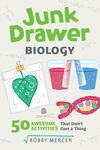
Unleash your inner scientist with 50 hands-on biology experiments using everyday household items!
Junk Drawer Biology makes learning fun and accessible for kids of all ages. Science educator Bobby Mercer provides step-by-step, illustrated experiments that explain the building blocks of living matter. Aspiring doctors can build a model of human lungs, budding gardeners will germinate beans, and all ages will enjoy a candy DNA model.
Educators and parents will find this a handy resource to teach children while having a lot of fun. Perfect for ages 9-12 and anyone interested in hands-on science!

Trade Paper, PDF, EPUB, Mobipocket
Published Oct 2015
Trade Paper, PDF, EPUB
Published Dec 2021
Trade Paper, PDF, EPUB, Mobipocket
Published May 2017
Trade Paper, PDF, EPUB, Mobipocket
Published Oct 2018
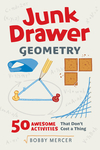
Unleash your child's inner mathematician with hands-on geometry projects!
For many children, geometry is best understood through hands-on activities. Junk Drawer Geometry provides 50 creative project ideas that make learning fun and engaging. Children will build polygons with pipe cleaners, explore Mobius strips with index cards, and model the Pythagorean Theorem with cheese crackers. Each activity includes a materials list and detailed instructions with illustrations. These projects introduce problem-solving skills and applied geometry in an exciting way.
Educators and parents will find this a handy resource to excite any classroom or home learning environment. Modify lessons for different age groups and make geometry an adventure!
Trade Paper, PDF, EPUB, Mobipocket
Published Jun 2014
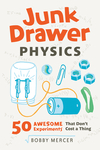
Finalist for the 2015 AAAS / Subaru SB&F Excellence in Science Book exemplify outstanding and engaging science writing and illustration for young readers
A children’s instructional book on how to use readily available materials to turn the house into a science lab
Physics teacher Bobby Mercer provides readers with more than 50 great hands-on experiments that can be performed for just pennies, or less. Turn a plastic cup into a pinhole camera using waxed paper, a rubber band, and a thumbtack. Build a swinging wave machine using a series of washers suspended on strings from a yardstick. Or construct your own planetarium from an empty potato chip canister, construction paper, scissors, and a pin. Each project has a materials list, detailed step-by-step instructions with illustrations, and a brief explanation of the scientific principle being demonstrated. Junk Drawer Physics also includes sidebars of fascinating physics facts, such as did you know the Eiffel Tower is six inches taller in summer than in winter because its steel structure expands in the heat? Educators and parents will find this title a handy resource to teach children about physics topics that include magnetism, electricity, force, motion, light, energy, sound, and more, and have fun at the same time.
Trade Paper, PDF, EPUB, Mobipocket
Published May 2012
Trade Paper, PDF, EPUB, Mobipocket
Published Oct 2013
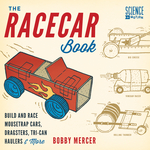
A project book for young readers with a need for speed, this work provides instruction on 25 easy-to-construct racecars that can be driven both indoors and out. They will learn how to use mousetraps, rubber bands, chemical reactions, gravity, and air pressure to power the cars that are made for little or no cost using recycled and repurposed materials. Readers will discover how to turn a potato chip can, a rubber band, and weights into a Chip-Can Dancer; retrofit a car with a toy plane propeller to make an air-powered Prop Car; and use an effervescent tablet in a small canister to make an impressive rocket engine for a Mini Pop Car. Each project is accompanied by a materials list, detailed step-by-step instructions with photos, and explanations of the science behind each racecar, including concepts such as friction, Newton’s laws of motion, and kinetic and potential energy.
PDF, EPUB, Mobipocket
Published Oct 2014
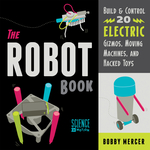
How to use reuse and recycle components and supplies to build a variety of devices
The 20 easy-to-build robots in this project book can be constructed for little or no cost using common household objects and repurposed materials. From learning how to turn a toothbrush, an old cell phone or pager, and scrap wire into a Brush Bot, or how to hack a toy car to hotwire a Not-So-Remote Bot, each hands-on project contains a materials list and detailed step-by-step instructions with photos. Explanations of the science and technology behind each robot—including concepts such as friction, weight and mass, center of gravity, kinetic and potential energy, electric circuitry, DC vs. AC current, and more—are also included.